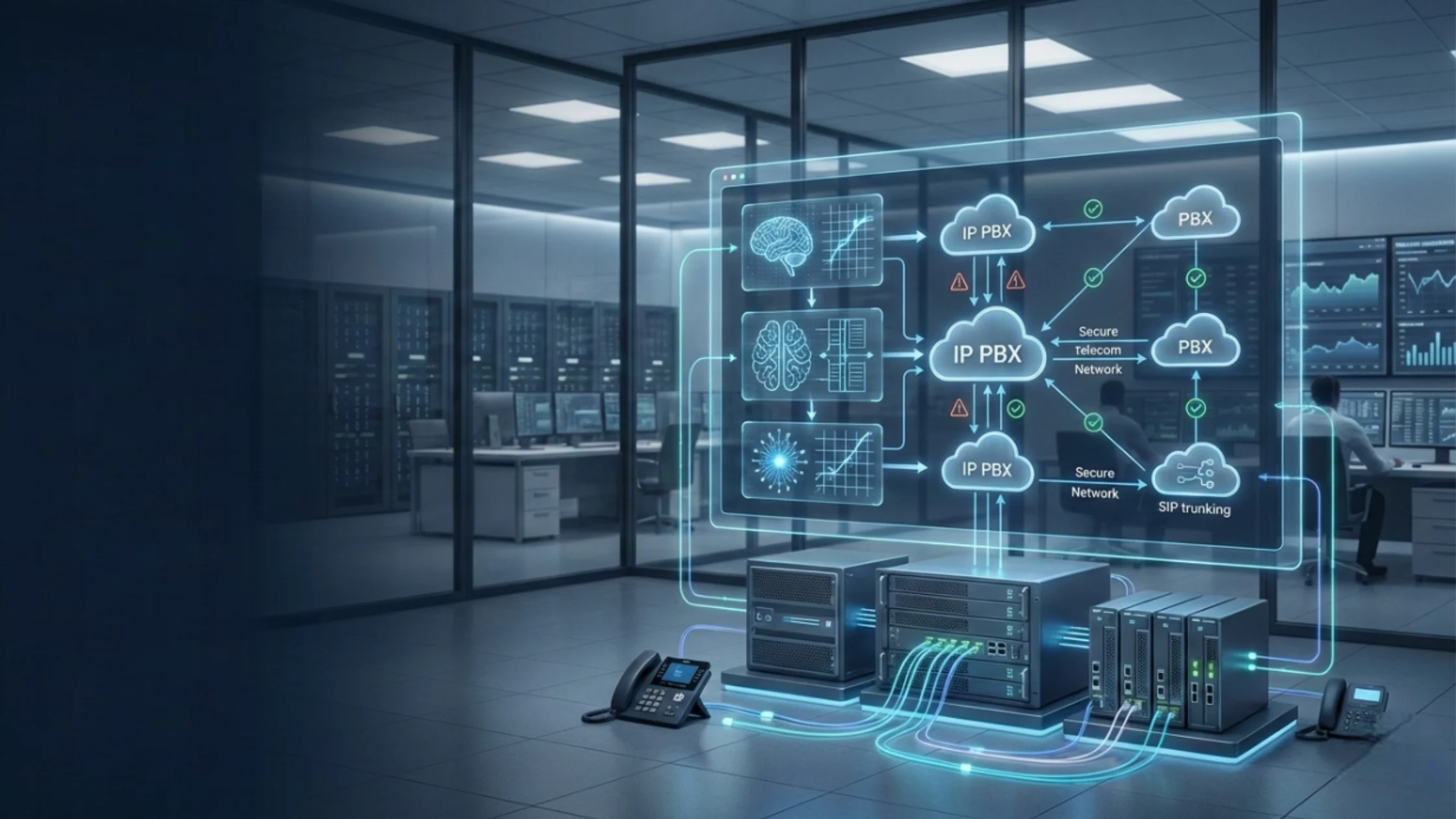
Remember when business phone systems meant bulky hardware boxes sitting in dusty server rooms, consuming space and requiring constant maintenance? Those days are rapidly fading. The telecommunications industry is experiencing a massive transformation, and artificial intelligence is at the heart of this revolution.
If you’re a telecom provider or decision-maker evaluating your communication infrastructure, you’re probably wondering: How exactly is AI reshaping IP PBX services, and what does this mean for my business?
Let’s dive deep into this transformation that’s redefining how we communicate.
The AI Revolution in Telecom: By the Numbers
The numbers tell a compelling story. The global AI in telecommunication market reached $1.45 billion in 2022 and is projected to hit $11.29 billion by 2030, growing at an impressive 28.2% CAGR.
But here’s what’s even more striking: nearly 90% of telecom companies are already using AI, with 48% piloting solutions and 41% actively deploying them.
This isn’t just a passing trend. Telecom providers recognize that AI adoption provides a competitive advantage, with 53% of service providers agreeing it gives them an edge in the market. The message is clear: AI-powered IP PBX systems aren’t the future, they’re the present.
What’s Driving This Massive Shift?
The migration toward AI-powered hosted PBX services isn’t happening in a vacuum. Several powerful forces are pushing this transformation forward, and understanding them helps explain why traditional phone systems are becoming obsolete.
Cost Pressures Are Real
Traditional on-premise PBX systems require substantial upfront investment in hardware, ongoing maintenance costs, and dedicated IT expertise. For many businesses, especially small to medium enterprises, this creates a significant financial burden. Cloud-hosted IP PBX solutions eliminate these pain points by operating on subscription models with minimal initial investment. You’re essentially shifting from capital expenditure to operational expenditure, freeing up resources for innovation rather than infrastructure maintenance.
The Remote Work Reality
The pandemic permanently altered workplace dynamics. Businesses now need communication systems that work seamlessly, whether employees are in the office, at home, or anywhere in between. Traditional PBX systems weren’t designed for this reality; they’re location-dependent and inflexible. AI-powered cloud PBX solutions offer location-agnostic connectivity, allowing teams to maintain professional communication standards regardless of physical location.
Customer Expectations Have Evolved
Today’s customers demand instant responses, personalized interactions, and 24/7 availability. Meeting these expectations with human agents alone is neither scalable nor cost-effective. AI-powered chatbots and virtual assistants have helped companies reduce customer service costs by 80%, while simultaneously improving response times and service quality. This isn’t about replacing humans; it’s about augmenting their capabilities and freeing them to handle complex issues that truly require human judgment.
5G and Network Complexity
The rollout of 5G networks introduces unprecedented complexity in network management. The volume of connected devices, data traffic patterns, and infrastructure components requires sophisticated monitoring and optimization that humans simply cannot handle manually. AI becomes essential for managing this complexity, enabling predictive maintenance and real-time network optimization.
How AI Is Transforming IP PBX Capabilities
The integration of AI into IP PBX systems isn’t just adding fancy features; it’s fundamentally reimagining what phone systems can do. Let’s explore the specific ways AI is making hosted PBX services smarter and more valuable.
Intelligent Call Routing That Actually Works
Traditional call routing followed simple rules: route based on time of day, department selection, or round-robin distribution. AI transforms this into something far more sophisticated.
Modern AI-powered systems analyze caller intent, emotional tone, conversation history, and even predict issue complexity to route calls to the most appropriate agent.
The system learns from past interactions, continuously improving its routing decisions. This means customers get faster resolutions, agents handle queries they’re best equipped for, and overall customer satisfaction improves dramatically.
Natural Language Processing Breaks Down Barriers
Interactive Voice Response (IVR) systems have historically been frustrating: press 1 for this, press 2 for that, press 0 to talk to a human (eventually).
AI-powered IVR with natural language processing changes everything. Callers can speak naturally, describing their needs in their own words, and the system understands and responds appropriately.
No more navigating complex menu trees or repeating information multiple times. The technology has matured to the point where distinguishing between human agents and AI assistants is becoming increasingly difficult.
Predictive Maintenance Prevents Problems Before They Happen
One of AI’s most valuable contributions is predictive analytics.
Instead of reacting to network issues after they’ve disrupted service, AI systems analyze patterns, detect anomalies, and predict potential failures before they occur.
This enables proactive maintenance during low-traffic periods, minimizing customer impact. Companies implementing AI-driven predictive maintenance have achieved 90% success rates in real-time fraud detection, demonstrating how effective these systems have become at pattern recognition and anomaly detection.
Real-Time Analytics Drive Better Decisions
AI doesn’t just handle calls; it generates actionable insights from every interaction.
Call duration patterns, common customer complaints, agent performance metrics, and conversation sentiment analysis provide managers with detailed visibility into operations.
These insights enable data-driven decision-making, identifying training needs, optimizing staffing levels, and spotting emerging issues before they become major problems.
Automated Assistants Handle Routine Tasks
A significant portion of customer service inquiries are routine, including password resets, account balance checks, appointment scheduling, and basic troubleshooting.
AI-powered virtual assistants excel at handling these repetitive tasks efficiently and consistently. This automation frees human agents to focus on complex issues requiring empathy, creativity, and nuanced judgment.
The result? 73% of companies report increased revenue through AI-driven network optimization, demonstrating the tangible business impact of intelligent automation.
The Cloud Advantage: Why Hosted Solutions Win
While AI can enhance both on-premise and cloud-based systems, hosted IP PBX solutions offer distinct advantages that make them the preferred choice for most organizations.
Scalability Without Hardware Hassles
Traditional PBX expansion meant ordering equipment, scheduling technician visits, and waiting weeks or months for implementation.
Cloud-hosted systems allow you to add or remove lines with a few clicks, scaling up during growth periods or seasonal peaks and scaling down when demand decreases.
You can follow cloud cost-optimization strategies to pay only for what you use, eliminating the waste of provisioning for theoretical future capacity.
Maintenance Becomes Someone Else’s Problem
Server maintenance, software updates, security patches, and system optimizations—these essential but time-consuming tasks shift entirely to your service provider with hosted solutions.
Your internal IT team can focus on strategic initiatives rather than keeping phone systems running.
Providers typically offer 99.999% uptime guarantees, ensuring reliability that would be challenging and expensive to achieve with on-premise systems.
Geographic Flexibility Creates Opportunities
Cloud-hosted systems aren’t tied to physical locations. This enables seamless multi-site communication, making calls between branches function as internal calls regardless of distance.
For businesses with remote workers, distributed teams, or multiple offices, this flexibility is invaluable.
Employees access the full feature set from anywhere with internet connectivity, using desk phones, computers, or mobile devices interchangeably.
Lower Total Cost of Ownership
While subscription costs are ongoing, they’re typically far lower than the combined costs of hardware purchase, installation, maintenance, upgrades, and dedicated IT expertise required for on-premise systems.
The predictable monthly expense simplifies budgeting, and the absence of large capital outlays improves cash flow.
Real Challenges Worth Considering
Despite the compelling benefits, adopting AI-powered hosted IP PBX systems isn’t without challenges. Understanding these potential obstacles helps you plan effectively and set realistic expectations.
Internet Dependency Creates Vulnerability
Cloud PBX systems require reliable internet connectivity. If your connection fails, so does your phone system. This dependency necessitates evaluating your internet infrastructure carefully, potentially investing in redundant connections or backup solutions.
For businesses in areas with unreliable internet service, this represents a significant concern that might justify hybrid or on-premise solutions.
Data Security and Privacy Concerns
Hosting your communication system in the cloud means trusting a third-party provider with sensitive business data and customer information.
While reputable providers implement robust security measures, the loss of direct control concerns some organizations, particularly those in highly regulated industries. Thorough vendor evaluation, clear service level agreements, and understanding data handling practices become essential.
Change Management and Training
Transitioning from familiar legacy systems to AI-powered platforms requires training and adjustment periods. Employees may resist change or struggle initially with new interfaces and features.
Successful implementations invest in comprehensive training, clear communication about benefits, and adequate support during the transition period.
Choosing the Right Provider Matters Enormously
Not all hosted PBX providers deliver equal value or reliability. Poor provider selection can result in subpar call quality, inadequate support, or feature limitations that frustrate rather than empower.
Due diligence in provider evaluation, examining uptime guarantees, support responsiveness, feature roadmaps, and customer references, is critical to successful implementation.
What’s Next: The Future of AI in Telecom
The AI revolution in telecommunications is still in its early stages. Several emerging trends will shape the next phase of innovation.
Generative AI Will Transform Customer Interactions
While current AI assistants follow programmed patterns and responses, generative AI enables more natural, contextual, and creative interactions.
These systems will handle increasingly complex customer inquiries, generate personalized responses, and even proactively engage customers with relevant information based on their behavior patterns and preferences.
Integration With Other AI Technologies
The convergence of IP PBX systems with Internet of Things devices, machine learning platforms, and business intelligence tools will create comprehensive communication ecosystems. Imagine phone systems that integrate with smart office environments, automatically adjusting based on occupancy patterns, or systems that trigger specific workflows based on call outcomes.
Enhanced Predictive Capabilities
As AI systems accumulate more data and their algorithms become more sophisticated, predictive capabilities will expand beyond maintenance into business intelligence. Systems will forecast call volumes with greater accuracy, predict customer churn based on interaction patterns, and identify sales opportunities through conversation analysis.
Greater Personalization
Future AI systems will deliver highly personalized communication experiences, remembering customer preferences, tailoring interactions based on individual history, and adapting responses to communication styles. This personalization will extend beyond customer service into marketing, sales, and internal communications.
Making the Decision: Is AI-Powered Hosted PBX Right for You?
The question isn’t really whether to adopt AI and cloud technologies; it’s when and how. The overwhelming industry momentum toward these solutions reflects their fundamental advantages. However, the right timing and approach depend on your specific circumstances.
Consider hosted AI-powered IP PBX if you:
- Want to reduce capital expenditure and predictable operational costs
- Need scalability to accommodate growth or seasonal fluctuations
- Support remote or distributed workforces
- Lack of extensive in-house IT expertise for system management
- Prioritize access to cutting-edge features and regular updates
- Value flexibility and rapid deployment
On-premise solutions might still make sense if you:
- Require absolute control over security and data
- Operate in areas with unreliable internet connectivity
- Have unique customization needs that hosted solutions can’t accommodate
- Possess significant existing hardware investments you want to leverage
- Work in industries with specific regulatory requirements
The Bottom Line
AI and automation aren’t just enhancing IP PBX-hosted services; they’re redefining what’s possible in business communications. The convergence of artificial intelligence, cloud computing, and telecommunications creates opportunities for efficiency, customer experience, and business insight that weren’t imaginable just a few years ago.
With more than half of telecom providers already integrating AI and automation, the transformation is well underway. Your communication system should be an asset that drives growth and empowers your team, not a burden that consumes resources. AI-powered hosted IP PBX solutions deliver on that promise.
The future of business communications is intelligent, flexible, and cloud-based. The only question is: Are you ready to embrace it?
