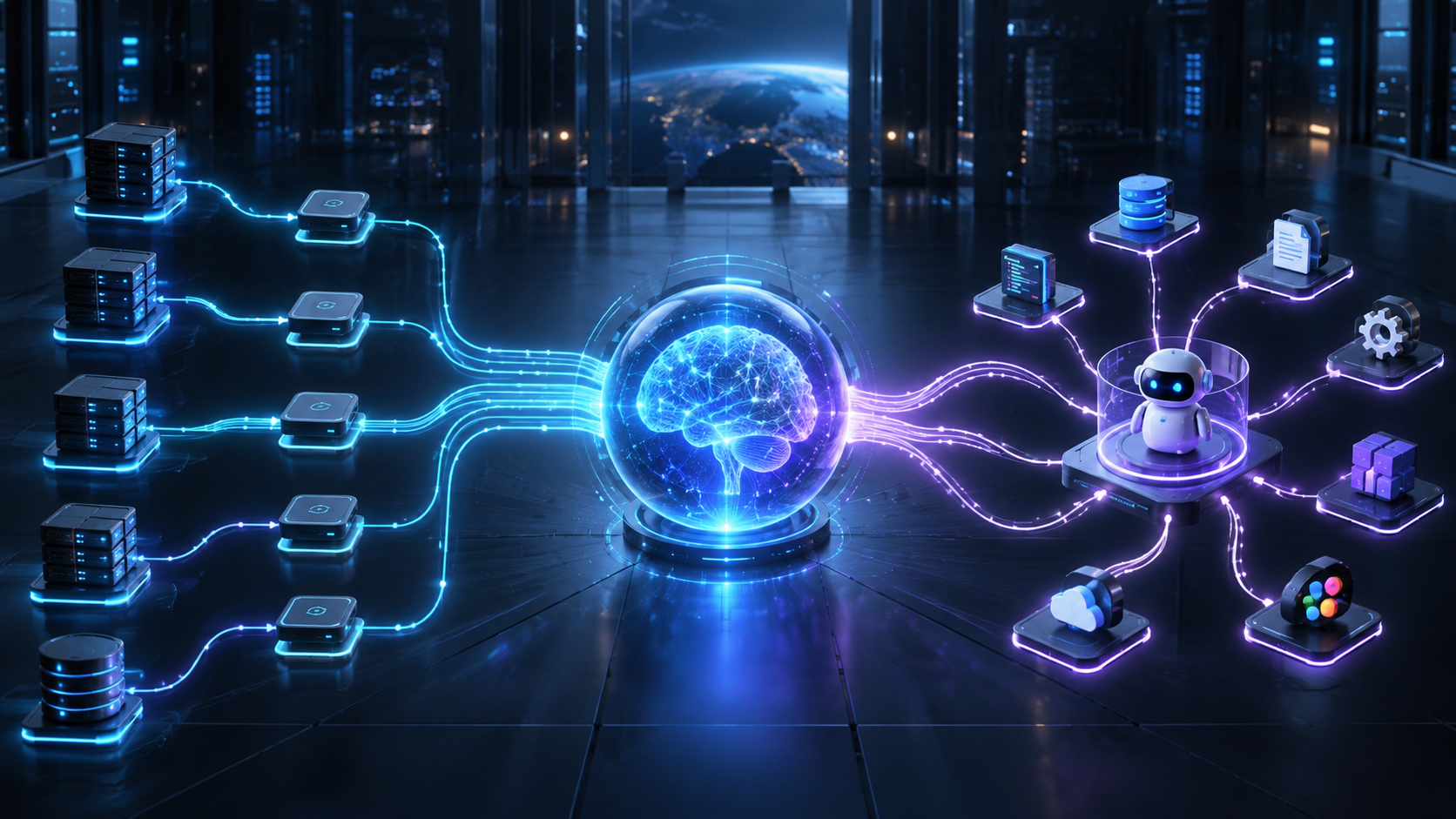
AI applications are evolving from systems that generate content into agents that can retrieve customer data, update records, trigger workflows, and interact with business systems. This shift is changing how applications connect with the software and data they rely on.
APIs have long provided the foundation for these integrations. But as businesses adopt agentic AI, Model Context Protocol (MCP) is emerging as a standardized way for AI applications to discover and interact with tools, services, and contextual data. This is also shaping how businesses approach AI development services, particularly when building applications that need to connect with multiple business systems.
So, MCP vs APIs, which approach should businesses use? The answer is not about replacing one with the other. APIs provide reliable access to applications and business logic, while MCP creates an AI-focused connectivity layer that can work with those existing systems. For many production AI applications, the future lies in using MCP and APIs together.
What Is an API?
An API, or Application Programming Interface, defines how one software system communicates with another. It specifies available operations, required inputs, response formats, authentication requirements, and error handling.
For example, an e-commerce application might use APIs to connect with:
- Payment gateways
- Customer relationship management systems
- Inventory databases
- Shipping platforms
- Analytics services
A traditional workflow might look like this:
Application – API – Business System
The application knows which service it needs and which endpoint to call. Developers build these integrations into the application logic. APIs remain essential for AI applications because AI systems still need reliable access to databases, SaaS platforms, business services, and internal applications.
REST APIs, GraphQL APIs, SDKs, and other interfaces can continue powering the underlying software architecture even when AI agents are introduced.
What Is Model Context Protocol (MCP)?
Model Context Protocol is an open standard designed to connect AI applications with external tools, data sources, and workflows. The important difference is discoverability.
With a conventional API integration, developers typically define which endpoints an application can call. With MCP, an AI application can discover available tools and their schemas through a standardized protocol. An MCP-based architecture can look like this:
AI Application – MCP Client – MCP Server – Business System
An MCP server can expose capabilities that an AI agent can use. Those capabilities may ultimately connect to an existing API, database, or other service.
The MCP project has continued to evolve rapidly. The July 2026 specification introduced a stateless protocol core, improved authorization, cacheable tool-list results, and other changes intended to improve reliability and scalability.
This makes MCP particularly relevant for applications where AI agents need to interact with multiple tools dynamically.
MCP vs API: What Is the Difference?
The simplest distinction is that an API exposes software capabilities. MCP standardizes how AI applications discover and interact with those capabilities.
| Factor | API | MCP |
| Primary purpose | Software-to-software communication | AI-to-tool and context connectivity |
| Main consumer | Applications and developers | AI applications and agents |
| Discovery | Usually defined during development | Supports runtime tool discovery |
| Interface | Service-specific | Standardized protocol |
| Workflow | Typically deterministic | Can support model-driven workflows |
| Best suited for | Backend and application integration | AI agents and multi-tool workflows |
| Existing systems | Directly exposes services | Can sit above APIs and other systems |
| Control | Application determines calls | AI application can select available tools |
The difference becomes clearer when looking at how each handles a request. nSuppose a company wants an AI assistant to retrieve customer information. With an API, developers might explicitly code:
AI application – CRM API – Customer data
The application knows which endpoint to use. With MCP, the architecture could be:
AI application – MCP server – CRM API – Customer data
The MCP server exposes a standardized tool that the AI application can discover and invoke. This does not mean MCP replaces the CRM API. The API can continue handling authentication, business rules, validation, and data access.
MCP vs REST API
REST is an architectural style commonly used for APIs. MCP is a protocol designed specifically around AI application connectivity. REST APIs are well suited to deterministic application workflows, traditional backend integrations, and high-volume data processing.
MCP becomes more useful when an AI agent needs to discover tools, understand their schemas, and select capabilities dynamically.
The distinction is therefore less about which technology is newer and more about who needs to interact with the system and how that interaction is determined. Recent comparisons similarly position REST for established and high-throughput workloads, while MCP is useful for agent-driven tool discovery.
MCP and APIs: How Do They Work Together?
One of the biggest misconceptions about MCP is that businesses must choose between MCP and APIs. In many cases, the better approach is to use them together. A production architecture might look like this:
User -AI Agent – MCP Client – MCP Server – API – Business System
Consider a customer support assistant. A user asks:
“Show me the latest orders from this customer and create a support ticket.”
The AI agent may need access to two capabilities:
- Retrieve order information.
- Create a support ticket.
An MCP server can expose these capabilities as tools. Behind the scenes, those tools can call existing order-management and support APIs. The business can therefore retain its existing application architecture while adding an AI-friendly connectivity layer.
This approach also avoids rebuilding core business logic specifically for AI. The role of API in mobile app development follows a similar principle: APIs connect the app with backend services while keeping core business logic and data processing on the server side. In an AI architecture, APIs can continue performing this role while MCP provides a standardized layer for agent interactions.
APIs remain the service boundary, while MCP can become the agent connectivity layer. This complementary model allows businesses to extend existing systems for AI without replacing the underlying integration infrastructure.
Building a Production MCP + API Architecture
Businesses adopting MCP should avoid exposing their entire backend directly to an AI model. A layered architecture provides better control.
AI Experience Layer
- AI chatbot: Conversational interface that lets users interact with business systems through natural language.
- Enterprise copilot: AI assistant that helps employees access information, complete tasks, and make decisions within business workflows.
- AI agent: Autonomous or semi-autonomous system that can plan tasks, select tools, and execute actions across connected systems.
- Voice assistant: Voice-enabled AI interface that lets users request information or trigger actions through spoken commands.
AI Connectivity Layer
- MCP clients: Components that connect AI applications to MCP servers and make their available tools accessible to the AI.
- MCP servers: Expose selected tools, resources, and capabilities from business systems to AI applications through MCP.
- Tool definitions: Describe what each tool does, its inputs, outputs, and how an AI application can use it.
- Permission controls: Define which users, agents, or AI applications can access specific tools and perform certain actions.
Application Layer
- REST APIs: Provide standardized endpoints for applications to request data or perform operations.
- GraphQL APIs: Allow applications to request specific data through a flexible query-based interface.
- Business services: Contain the core application functions and workflows that support business operations.
- Authentication: Verifies the identity of users, applications, or services requesting access.
- Validation: Checks incoming data and requests against defined rules before processing them.
- Business rules: Define how the application should process transactions, decisions, and workflows.
Data Layer
- CRM: Stores customer profiles, interactions, sales activities, and related business data.
- ERP: Manages core business processes such as finance, inventory, procurement, and operations.
- Databases: Store structured and unstructured application data required by business systems.
- SaaS applications: Provide external business capabilities such as customer support, payments, analytics, or collaboration.
- Internal systems: Include proprietary applications and data sources built specifically for an organization’s operations.
This separation allows businesses to introduce AI without moving core business logic into the model layer.
An MCP server can expose only the capabilities an agent actually needs. The underlying application services can continue enforcing permissions, validation, transactions, and business rules. Microsoft’s current agent framework documentation also demonstrates MCP servers being used as standardized tool interfaces that compatible agents can consume.
Security and Scalability Considerations
MCP introduces another access layer between AI applications and business capabilities. Security therefore needs to be designed into the architecture from the beginning.
Businesses should evaluate:
- Authentication
- Authorization
- Tool-level permissions
- Sensitive data exposure
- Prompt injection risks
- Human approval for high-impact actions
- Audit logging
- Third-party MCP server trust
- API rate limits
The latest MCP specification includes authorization hardening and other changes aimed at improving production deployments. Scalability also depends on the workload.
MCP may be suitable for interactive agent workflows where tools are discovered and called as needed. Direct APIs can remain more appropriate for high-volume transactions, batch processing, and predictable backend operations. The best architecture does not force every workload through the same connectivity layer.
The Future of AI Application Connectivity
The future of AI connectivity is unlikely to be MCP versus APIs. Instead, businesses are likely to use layered architectures where APIs continue powering software systems while MCP provides standardized access for AI applications.
This becomes increasingly important as businesses deploy AI agents across CRM, ERP, customer support, analytics, productivity, and internal operations.
The MCP ecosystem is already expanding rapidly. The MCP maintainers reported nearly half a billion monthly downloads across Tier 1 SDKs by July 2026, alongside major protocol improvements aimed at production-scale agent workflows.
The practical takeaway is straightforward: APIs connect applications and services. MCP connects AI applications with tools and context. For many businesses, using both will provide the most flexible architecture.
Conclusion
MCP and APIs are not competing technologies designed to solve the same problem. APIs provide reliable, controlled access to software systems. MCP provides a standardized way for AI applications to discover and interact with tools and contextual resources.
Use APIs for deterministic application workflows, backend integrations, and high-volume processing. Add MCP when AI agents need dynamic tool discovery, multi-system access, or standardized AI-facing connectivity. For businesses exploring these architectures, AppDevGuides can provide practical guidance on building scalable AI-powered applications and choosing the right connectivity approach. For most production AI applications, the strongest approach is not choosing between MCP and APIs, but designing an architecture where MCP works with existing APIs to make business systems accessible to AI agents without rebuilding the underlying software infrastructure.
FAQs
1. Is MCP replacing APIs?
No, MCP does not replace APIs. An MCP server can use existing APIs to expose business capabilities to AI applications through a standardized interface.
2. Is MCP better than a REST API?
Neither is universally better. REST APIs are effective for deterministic application workflows and high-volume integrations. MCP is better suited to AI agents that need dynamic tool discovery and multi-tool interactions.
3. Can MCP work with existing APIs?
Yes. An MCP server can sit between an AI application and existing APIs. The MCP layer exposes selected capabilities while the underlying APIs continue handling business logic and data access.
4. What is the difference between MCP and function calling?
Function calling allows an AI model to request a defined function. MCP provides a standardized protocol for discovering and interacting with tools and contextual resources across compatible systems.
5. Should businesses use MCP and APIs together?
In many production AI architectures, yes. APIs can remain responsible for application and business logic, while MCP provides AI agents with standardized access to selected tools and capabilities.
