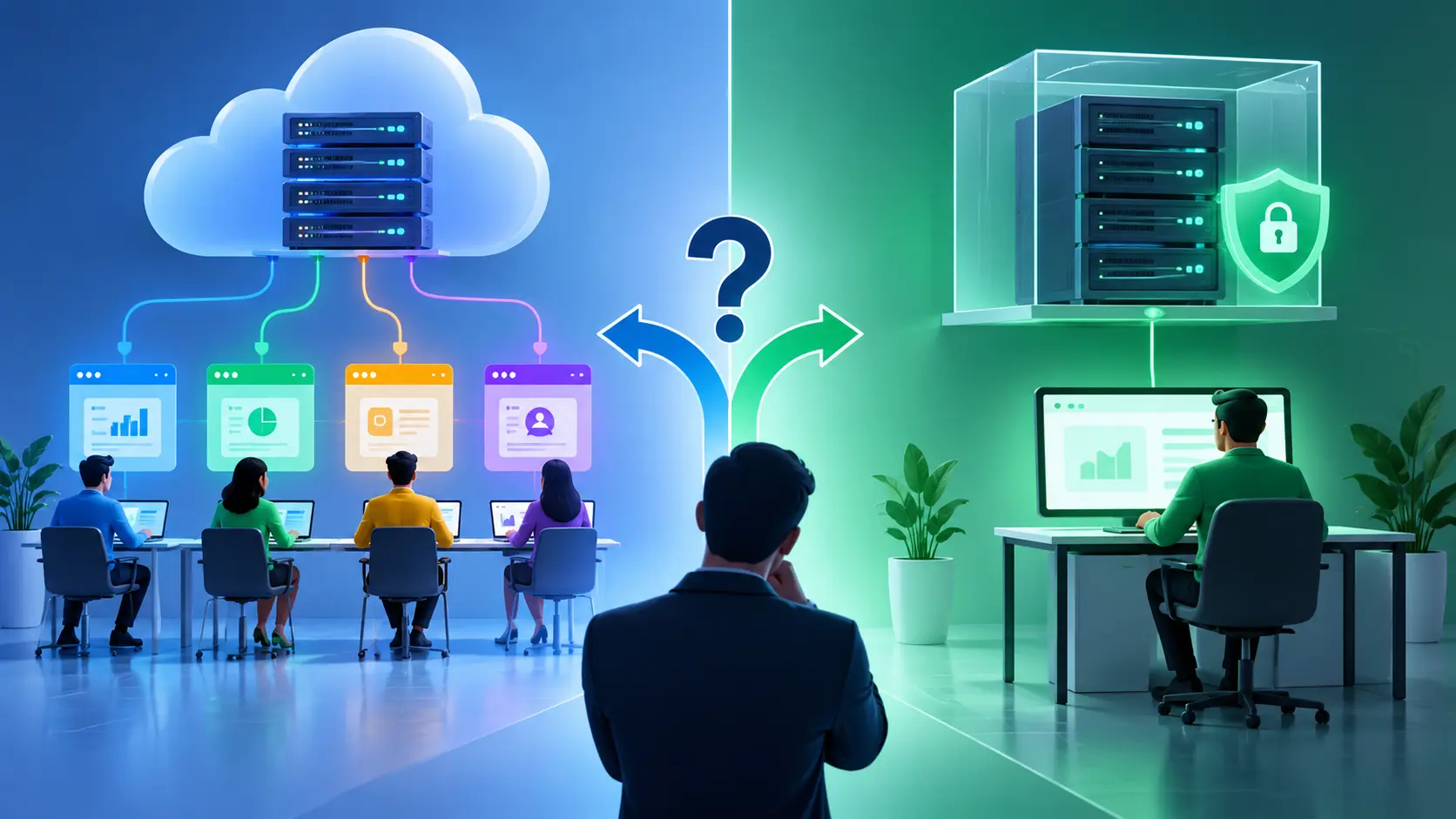
SaaS architecture plays a major role in how efficiently a software product can scale, manage customers, control infrastructure costs, and maintain security. Among the most important architectural decisions for a SaaS product is whether to use a multi-tenant or single-tenant model.
In a multi-tenant SaaS architecture, multiple customers share the same application infrastructure while their data and access remain logically isolated. In a single-tenant architecture, each customer receives a dedicated application environment or infrastructure instance.
Neither approach is universally better. The right choice depends on your target customers, security requirements, expected scale, customization needs, compliance obligations, and budget. Understanding the differences between multi-tenant and single-tenant SaaS can help businesses select an architecture that supports both current requirements and long-term growth. Businesses planning their SaaS product can also work with an experienced SaaS app development company to evaluate the right architecture and build a scalable foundation.
What is Multi-Tenant SaaS Architecture?
Multi-tenant SaaS architecture allows multiple customers, commonly called tenants, to use the same application environment. The underlying application, database infrastructure, servers, and other resources may be shared, while tenant-specific data remains logically separated.
For example, imagine a project management SaaS platform used by 500 companies. All 500 companies may access the same application codebase and infrastructure, but each organization can only access its own projects, users, tasks, and reports.
The primary advantage of this model is resource efficiency. Instead of maintaining a separate environment for every customer, the SaaS provider operates a shared infrastructure that can support many tenants. This makes multi-tenancy particularly attractive for SaaS products targeting a large number of customers with similar requirements.
How Does Multi-Tenant SaaS Work?
A multi-tenant application typically identifies the tenant associated with every user request. The system then ensures that the user can access only the resources belonging to that tenant. Tenant isolation can be implemented through different database strategies. A SaaS platform may use a shared database with tenant identifiers, separate schemas within the same database, or separate databases for individual tenants while still sharing the application layer.
The architecture selected depends on security, scalability, compliance, and operational requirements. A well-designed multi-tenant system also requires strong authorization controls. Authentication determines who the user is, while tenant-aware authorization determines which organization’s data that user can access.
What is Single-Tenant SaaS Architecture?
Single-tenant SaaS architecture provides a dedicated environment for each customer. Depending on the implementation, a tenant may have its own application instance, database, server resources, or complete cloud environment.
For example, an enterprise customer purchasing a SaaS platform may receive a dedicated database and application environment that is not shared with other customers. Single-tenancy provides greater infrastructure isolation and can make it easier to satisfy customers with strict security, compliance, data residency, or customization requirements.
However, this isolation comes with additional infrastructure and operational costs. As the customer base grows, the SaaS provider may need to provision, monitor, update, secure, and maintain many separate environments.
Multi-Tenant vs Single-Tenant SaaS: Key Differences
The most important differences between the two models relate to infrastructure, cost, scalability, security, customization, and maintenance.
| Factor | Multi-Tenant SaaS | Single-Tenant SaaS |
| Infrastructure | Shared | Dedicated |
| Cost per customer | Lower | Higher |
| Scalability | Highly efficient | Requires additional environments |
| Customization | More standardized | Greater flexibility |
| Data isolation | Logical isolation | Physical or environment-level isolation |
| Maintenance | Centralized | Tenant-specific |
| Updates | Easier to roll out globally | May require separate deployments |
| Resource utilization | Higher | Lower |
| Enterprise suitability | Suitable for many enterprises | Strong fit for highly regulated enterprises |
The decision should not be based only on infrastructure cost. A SaaS provider must also consider operational complexity and the expectations of its target customers.
Advantages of Multi-Tenant SaaS
One of the biggest benefits of multi-tenancy is cost efficiency. Shared infrastructure allows providers to distribute infrastructure expenses across multiple customers. This can reduce the cost of serving each tenant and make subscription pricing more competitive.
Multi-tenant systems are also easier to scale when the product has a large customer base. Instead of provisioning a completely new environment for every customer, the provider can increase the capacity of the shared infrastructure as demand grows.
Another advantage is centralized maintenance. When the application needs a security patch, performance improvement, or feature update, the provider can generally deploy it across the shared environment instead of managing hundreds of separate installations.
Multi-tenancy can also improve resource utilization. Customers rarely consume infrastructure resources at exactly the same time or at the same level, allowing the platform to optimize available capacity. For startups and SaaS companies pursuing rapid growth, these advantages can significantly simplify operations.
Limitations of Multi-Tenant SaaS
The shared nature of multi-tenancy can create challenges around data isolation and security. A tenant should never be able to access another tenant’s information because of an authorization, configuration, or application-level error.
Customization can also be more complicated. If one customer requests a highly specialized workflow that conflicts with the standard product architecture, implementing it without affecting other tenants may require additional engineering.
Performance isolation is another consideration. A tenant generating unusually high traffic or consuming significant resources could affect other customers if the architecture does not include appropriate resource controls.
Compliance requirements can also influence the decision. Certain customers may require dedicated infrastructure, specific data residency arrangements, or stronger environment-level isolation.
Advantages of Single-Tenant SaaS
The primary advantage of single-tenancy is isolation. Each customer can have a dedicated environment, reducing concerns about shared infrastructure and making it easier to apply customer-specific security controls.
Single-tenant architecture also provides greater customization flexibility. A provider can configure infrastructure, integrations, databases, deployment processes, and application settings for an individual customer without necessarily affecting others.
This model can be particularly useful for enterprise SaaS products where customers have strict regulatory or internal security requirements. Performance isolation is another benefit. Since infrastructure resources are dedicated, one customer’s usage is less likely to directly affect another customer’s application environment.
Single-tenancy can therefore be a strong option for businesses selling high-value enterprise subscriptions where customers are willing to pay more for dedicated infrastructure and customization.
Limitations of Single-Tenant SaaS
The biggest disadvantage is cost. Maintaining separate environments requires additional infrastructure resources, monitoring, deployment processes, backups, security controls, and operational effort.
Maintenance can also become complicated as the customer base grows. If a SaaS company has hundreds of dedicated environments, every environment needs to remain secure, updated, monitored, and available.
Software updates may require more planning as well. A centralized update can be relatively straightforward in a multi-tenant environment, while single-tenant deployments may require coordinated updates across multiple customer environments. Infrastructure utilization can also be less efficient because resources dedicated to one customer may remain underused during periods of low demand.
Which SaaS Architecture Is More Secure?
Security depends more on architecture quality and implementation than on tenancy alone. A properly designed multi-tenant platform can provide strong security through tenant isolation, encryption, access controls, secure APIs, monitoring, and robust authorization mechanisms. However, tenant isolation must be carefully engineered and continuously tested.
Single-tenant architecture can reduce certain risks because customer environments are separated. It can also make security policies easier to customize for individual enterprise customers.
However, dedicated infrastructure does not automatically make an application secure. Poor identity management, vulnerable APIs, weak access controls, outdated dependencies, or misconfigured cloud infrastructure can still create serious security problems. Therefore, organizations should evaluate the actual security architecture rather than assuming that single-tenancy is automatically safer.
How Does SaaS Architecture Affect Cost?
Architecture has a direct impact on both development and operational costs. Multi-tenant SaaS generally has a lower infrastructure cost per customer because resources are shared. It can also reduce operational overhead because deployments, monitoring, backups, and maintenance can be centralized. These considerations should also be evaluated alongside the mobile app development lifecycle, particularly when the SaaS platform is supported by mobile applications that require ongoing updates, testing, and maintenance.
Single-tenant SaaS usually requires greater investment because each customer may need dedicated resources. However, the higher cost can be justified when customers have high contract values or require dedicated environments.
For an early-stage SaaS company, multi-tenancy can provide a more efficient path to market. As the business grows, a hybrid approach can also be introduced where standard customers use shared infrastructure while enterprise customers receive dedicated environments.
When Should You Choose Multi-Tenant SaaS?
Multi-tenancy is generally appropriate when your SaaS product targets many customers with broadly similar requirements. It is especially useful when affordability, rapid scaling, centralized management, and efficient infrastructure utilization are important.
A startup launching a subscription-based CRM, project management tool, HR platform, marketing application, or collaboration product may benefit from multi-tenancy. It is also a strong choice when the business expects customer volume to grow significantly and wants to keep operational complexity under control.
When Should You Choose Single-Tenant SaaS?
Single-tenancy becomes more attractive when customers require dedicated infrastructure, extensive customization, strict compliance controls, or stronger environment-level isolation.
It may be appropriate for healthcare, financial services, government, defense, or other enterprise environments where customers have specific security and regulatory requirements.
It can also make sense when individual customers generate significant revenue and are willing to pay a premium for dedicated environments.
Can You Combine Multi-Tenant and Single-Tenant Architecture?
Yes. A hybrid SaaS architecture can combine both approaches. For example, a SaaS provider could offer a shared multi-tenant environment for standard customers and dedicated environments for enterprise customers. The application can maintain a common product experience while allowing infrastructure isolation for customers with advanced requirements.
This model can provide a balance between scalability and enterprise flexibility. However, it also introduces architectural and operational complexity because the platform must support multiple deployment patterns. Businesses considering this approach should define clear boundaries between the shared and dedicated environments before development begins.
How to Choose the Right SaaS Architecture
The best architecture depends on your product strategy rather than a simple preference for shared or dedicated infrastructure. Consider your target customer profile, pricing model, compliance requirements, customization expectations, projected customer volume, infrastructure budget, and operational capabilities.
A startup targeting thousands of small and mid-sized businesses will usually have different architectural requirements from an enterprise SaaS provider serving a few highly regulated organizations.
The architecture should also support future growth. Choosing an approach that works for the first 20 customers but becomes difficult to operate at 2,000 customers can create significant technical debt.
For many SaaS businesses, starting with a well-designed multi-tenant architecture is a practical approach. Businesses with demanding enterprise requirements may instead choose single-tenancy or a hybrid architecture from the beginning.
SaaS Architecture: Key Factors to Evaluate
When making the decision, evaluate these areas carefully:
- Customer requirements, security expectations, compliance obligations, customization needs, projected scale, infrastructure budget, performance requirements, and long-term maintenance complexity.
The architecture should be selected based on business economics as well as technical requirements.
Final Thoughts
Choosing between multi-tenant and single-tenant SaaS architecture is ultimately a business and technology decision. Multi-tenancy offers better infrastructure efficiency, centralized maintenance, and scalability, making it suitable for SaaS products serving a large and diverse customer base. Single-tenancy provides stronger environment-level isolation and greater customization, making it attractive for enterprise and highly regulated customers.
There is also no requirement to permanently choose one model. A hybrid architecture can provide shared infrastructure for standard customers and dedicated environments for enterprise accounts.
Before making the decision, evaluate your target market, security requirements, compliance obligations, expected growth, customization needs, and total cost of ownership. Working with an experienced SaaS app development company can help you design an architecture that supports both your current product requirements and future scaling plans. You can also explore AppDevGuides for practical insights into software architecture, development, and technology decisions.
FAQs
1. What is the main difference between multi-tenant and single-tenant SaaS?
Multi-tenant SaaS allows multiple customers to share application infrastructure while keeping their data logically isolated. Single-tenant SaaS provides a dedicated environment or infrastructure for each customer.
2. Is multi-tenant SaaS cheaper than single-tenant SaaS?
Generally, yes. Multi-tenancy allows infrastructure and operational resources to be shared across customers, which can lower the cost per tenant. Single-tenancy requires dedicated resources and usually has higher infrastructure and maintenance costs.
3. Is single-tenant SaaS more secure?
Single-tenancy can provide stronger environment-level isolation, but it is not automatically more secure. Security depends on identity management, authorization, encryption, infrastructure configuration, monitoring, application security, and other controls.
4. Which architecture is better for enterprise SaaS?
It depends on enterprise requirements. Multi-tenancy can work well for enterprises when strong logical isolation and compliance controls are sufficient. Single-tenancy may be preferable when customers require dedicated infrastructure, extensive customization, or strict isolation.
5. Can a SaaS product switch from multi-tenant to single-tenant later?
Yes, but the transition can require significant architectural planning, data migration, infrastructure changes, deployment redesign, and testing. Designing the platform with future tenancy requirements in mind can make such transitions easier.
