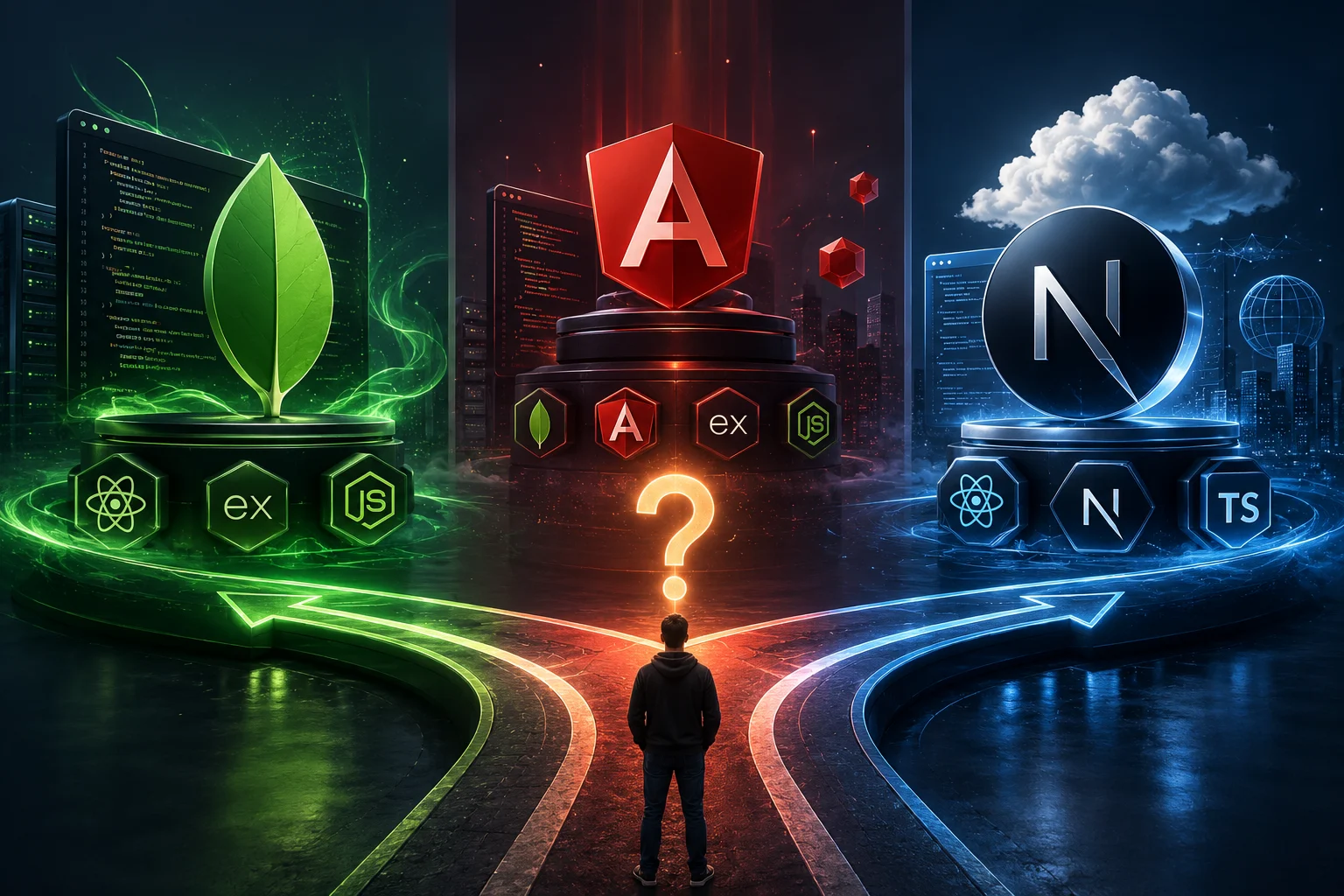
Choosing the right technology stack is one of the most important decisions in modern web development. The technologies you select determine how quickly your application can be built, how well it performs under growing user demand, how easily new features can be added, and how much it will cost to maintain in the future. A well-chosen tech stack not only improves development efficiency but also provides the flexibility needed to support business growth.
JavaScript has transformed the way web applications are developed by enabling developers to build both the frontend and backend using the same programming language. This unified approach has simplified development workflows and accelerated project delivery, making JavaScript-based frameworks the preferred choice for startups and enterprises alike.
Among the most popular options are MERN, MEAN, and Next.js. Although they all belong to the JavaScript ecosystem, they are designed with different goals in mind. Some focus on flexibility, others emphasize enterprise-grade architecture, while some prioritize speed and search engine optimization.
Partnering with an experienced full stack development company can help businesses evaluate their project requirements, scalability goals, and long-term maintenance needs before selecting the most suitable technology stack. Instead of following industry trends, the focus should always be on choosing a solution that aligns with your business objectives. In this guide, we’ll explore MERN, MEAN, and Next.js, understand how each technology works, and compare their strengths to help you make an informed decision.
Understanding MERN, MEAN, and Next.js
Although these technologies are often compared, they are not identical. MERN and MEAN are complete full-stack development stacks, while Next.js is a React framework that enhances frontend development with advanced rendering and performance capabilities.
Understanding how each technology fits into the development process makes it easier to determine which one is best suited for your project.
What is the MERN Stack?
The MERN stack is a JavaScript-based technology stack that combines MongoDB, Express.js, React, and Node.js to build complete web applications. MongoDB serves as the database, Express.js manages server-side functionality, Node.js provides the runtime environment, and React powers the user interface. Since every layer uses JavaScript, developers can work across the entire application without switching between multiple programming languages.
One of MERN’s biggest strengths is its flexibility. React’s component-based architecture allows developers to build dynamic and reusable interfaces, while MongoDB’s document-oriented database easily adapts to changing business requirements. This combination makes MERN a popular choice for startups, SaaS products, ecommerce platforms, and social networking applications that require highly interactive user experiences.
Its extensive ecosystem is another advantage. Developers have access to thousands of open-source libraries, making it easier to integrate authentication, payment gateways, cloud services, analytics tools, and third-party APIs. However, MERN also requires developers to assemble several supporting libraries for routing, state management, and other frontend capabilities. While this provides greater flexibility, it also demands careful project architecture to ensure maintainability as applications grow.
What is the MEAN Stack?
The MEAN stack consists of MongoDB, Express.js, Angular, and Node.js. Like MERN, it uses JavaScript across both the frontend and backend, but Angular replaces React as the frontend technology.
Unlike React, Angular is a complete frontend framework that includes many features developers often need to install separately in React projects. Routing, dependency injection, form handling, state management, and testing capabilities are built directly into Angular, providing a more structured development experience.
Because of this integrated architecture, MEAN is widely used for enterprise-grade software where consistency, maintainability, and standardized coding practices are essential. Large organizations often prefer Angular because its opinionated structure helps development teams follow uniform coding standards across complex applications.
MEAN is commonly adopted for enterprise resource planning systems, customer relationship management platforms, healthcare software, banking applications, and other business-critical solutions that require long-term scalability. The trade-off is complexity. Angular has a steeper learning curve than React, requiring developers to understand concepts such as dependency injection, modules, services, and TypeScript before becoming fully productive. For smaller projects or rapidly evolving startups, this additional complexity may increase initial development time.
What is Next.js?
Next.js differs from both MERN and MEAN because it is not a complete full-stack technology stack. Instead, it is a React framework designed to improve application performance, developer experience, and search engine optimization.
Traditional React applications rely heavily on client-side rendering, where browsers download JavaScript before displaying content. While this approach works well for interactive applications, it can impact page loading speed and search engine visibility.
Next.js addresses these challenges by introducing multiple rendering methods, including server-side rendering, static site generation, and incremental static regeneration. These capabilities allow pages to load faster while improving indexing by search engines.
In addition to advanced rendering, Next.js provides built-in routing, image optimization, automatic code splitting, metadata management, API routes, and deployment optimizations. These features reduce the amount of configuration developers typically need when building production-ready React applications.
Rather than replacing backend technologies like Node.js, Next.js is often integrated with APIs, databases, or backend services depending on project requirements. This flexibility makes it suitable for both standalone frontend applications and complete full-stack architectures.
Businesses building ecommerce websites, SaaS platforms, marketplaces, booking systems, blogs, and corporate websites increasingly choose Next.js because it delivers excellent performance without sacrificing developer productivity.
MERN vs MEAN vs Next.js: Feature-by-Feature Comparison
Now that you understand the fundamentals of each technology, the next step is to compare them across the factors that matter most during software development. While all three technologies leverage JavaScript, their strengths differ based on application requirements, development approach, and business goals.
| Feature | MERN | MEAN | Next.js |
| Frontend | React | Angular | React + Next.js |
| Backend | Express.js + Node.js | Express.js + Node.js | API Routes or External Backend |
| Database | MongoDB | MongoDB | Flexible (MongoDB, PostgreSQL, MySQL, etc.) |
| SEO | Moderate | Moderate | Excellent |
| Development Speed | Fast | Moderate | Fast |
| Learning Curve | Moderate | High | Moderate |
| Best For | Startups & SaaS | Enterprise Software | SEO-Driven Web Apps |
The best technology stack depends on what you want your application to achieve rather than which framework is currently the most popular.
1. Performance
Performance plays a major role in user satisfaction and business success. Applications that load quickly and respond instantly are more likely to retain users and improve conversions.
MERN delivers excellent performance through React’s Virtual DOM, which updates only the parts of a page that change instead of reloading the entire interface. Combined with Node.js’ non-blocking architecture, MERN efficiently handles real-time interactions, making it ideal for dashboards, collaboration platforms, and social applications.
MEAN also provides strong performance, particularly for large business applications. Angular includes built-in optimization techniques such as Ahead-of-Time (AOT) compilation and lazy loading that help maintain responsiveness as projects grow. Although Angular applications can initially be larger than React applications, they perform consistently in complex enterprise environments.
Next.js takes performance a step further by supporting server-side rendering and static site generation. Since pages can be generated before reaching the user’s browser, loading times are significantly reduced. Features like automatic code splitting and image optimization further enhance application speed, making Next.js an excellent choice for customer-facing websites.
2. Scalability
As applications grow, they must support increasing numbers of users, larger datasets, and additional business features without compromising performance.
MERN offers excellent scalability because React’s modular architecture simplifies feature expansion while MongoDB’s flexible schema adapts easily to changing business requirements. Node.js also supports scalable backend architectures through microservices and cloud deployments.
MEAN is equally scalable but focuses more on long-term maintainability. Angular’s structured framework helps multiple development teams collaborate efficiently, making it a preferred choice for enterprise systems that continue evolving over many years.
Next.js also scales exceptionally well on modern cloud platforms. Developers can optimize different pages using server-side rendering, static generation, or client-side rendering depending on application requirements, allowing businesses to balance performance with infrastructure costs.
3. Development Experience
Development speed often determines how quickly businesses can launch new products and respond to market demands.
MERN is known for rapid development because React allows developers to build reusable UI components while leveraging a vast ecosystem of third-party libraries. This flexibility makes it particularly attractive for startups and MVP development.
MEAN generally requires more initial setup and developer expertise due to Angular’s comprehensive architecture. However, many essential features are already built into Angular, reducing the need for external dependencies in large applications.
Next.js combines React’s familiar development model with built-in routing, image optimization, API handling, and rendering capabilities. These features reduce configuration time and enable developers to focus on building business functionality instead of project setup.
Which Tech Stack Should You Choose?
The ideal technology stack depends entirely on your project goals.
Choose MERN if you:
- Need to launch an MVP or startup product quickly.
- Are building SaaS platforms, marketplaces, or social networking apps.
- Want a flexible tech stack with a vast JavaScript ecosystem.
- Require highly interactive and dynamic user interfaces.
- Plan to scale your application as your user base grows.
Choose MEAN if you:
- Are developing enterprise-grade business applications.
- Need a structured architecture for large development teams.
- Prioritize long-term maintainability and code consistency.
- Are building ERP, CRM, healthcare, or financial software.
- Prefer Angular’s built-in features over third-party libraries.
Choose Next.js if you:
- Need excellent SEO and fast page loading speeds.
- Are building ecommerce websites or content-driven platforms.
- Want better Core Web Vitals and search engine visibility.
- Require server-side rendering or static site generation.
- Aim to deliver a high-performance user experience.
Ultimately, there is no universally superior technology stack. The right choice depends on your application’s functionality, expected user traffic, scalability requirements, and future business objectives.
Final Thoughts
Choosing between MERN, MEAN, and Next.js ultimately comes down to your business objectives, project complexity, scalability requirements, and performance expectations. MERN is an excellent choice for startups and dynamic web applications, MEAN is well suited for enterprise software that requires a structured architecture, and Next.js stands out for building fast, SEO-friendly, and user-centric digital experiences.
Instead of selecting a technology based on current trends, focus on the stack that best supports your product vision, future growth, and maintenance strategy. Making the right decision at the beginning of your project can reduce development costs, improve scalability, and accelerate time to market.
At AppDevGuides, we share expert insights, practical development strategies, and technology comparisons to help businesses make informed software development decisions. Whether you’re planning your first web application or modernizing an existing product, staying informed about the latest development technologies is the first step toward building a successful digital solution.
FAQs
1. Which is better, MERN, MEAN, or Next.js?
There is no one-size-fits-all answer. MERN is ideal for flexible and interactive applications, MEAN is better suited for enterprise software, while Next.js is the preferred choice for SEO-focused and high-performance web applications.
2. Is Next.js replacing the MERN stack?
No. Next.js is a React framework, not a complete full-stack replacement. It is often used alongside backend technologies such as Node.js, Express.js, or serverless APIs.
3. Which stack is best for startup development?
MERN is commonly preferred for startups because it supports rapid development, offers a large developer ecosystem, and makes it easier to build scalable MVPs.
4. Is Angular better than React for enterprise applications?
Angular is often favored for large enterprise applications because of its structured architecture, built-in features, and strong TypeScript support. However, React remains a popular choice for many enterprise projects due to its flexibility.
5. Which technology is best for SEO?
Next.js offers the strongest SEO capabilities because it supports server-side rendering, static site generation, and other built-in optimizations that improve search engine visibility and page performance.
