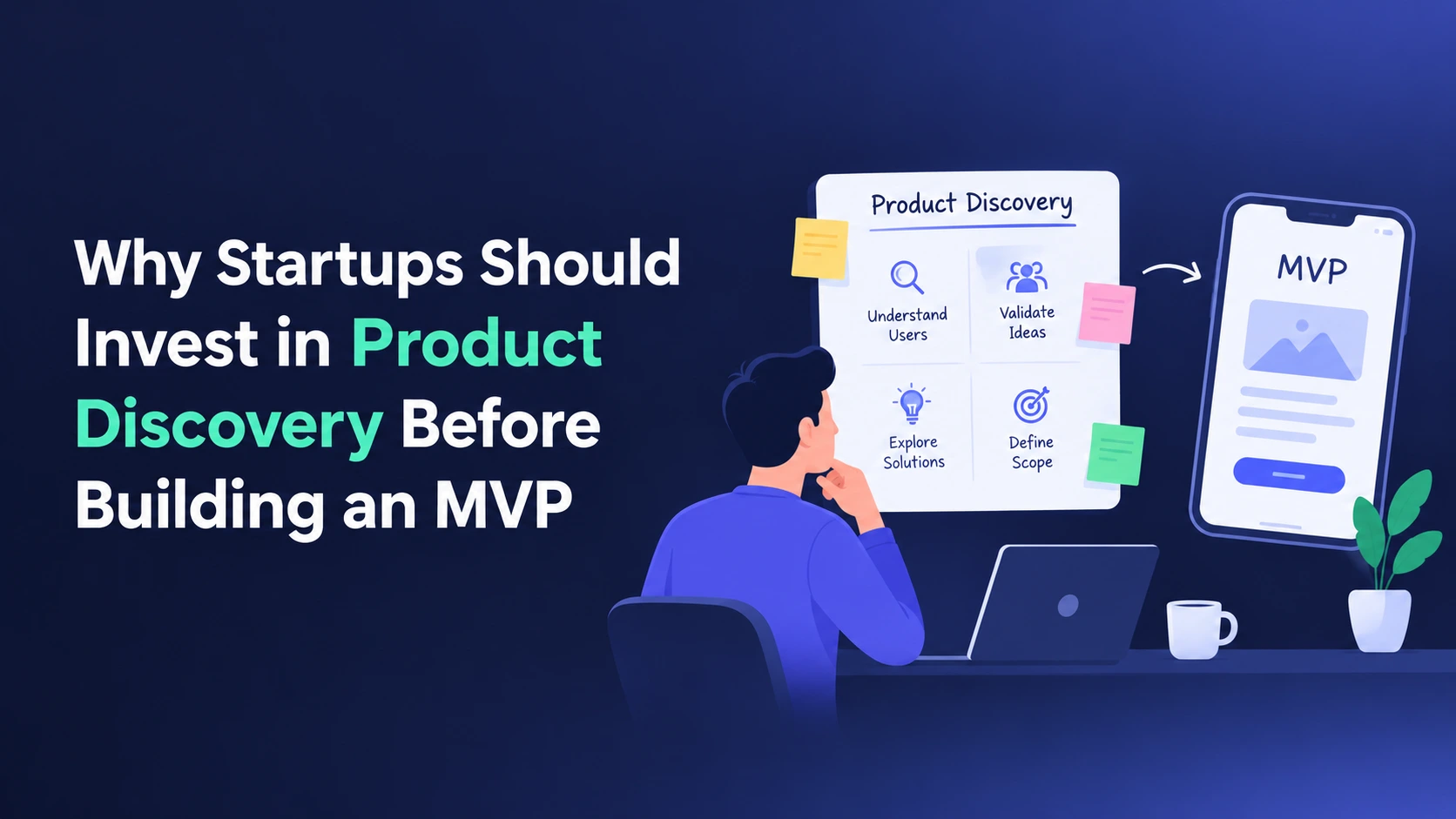
For startups, building an MVP can feel like the fastest way to turn an idea into a working product. But moving straight from an idea to development can create expensive problems when the product is based on untested assumptions.
Product discovery gives startups a structured way to understand users, validate the problem, study the market, define requirements, and decide what the MVP actually needs. Investing in product discovery services before development can help teams reduce uncertainty and build a product around a problem that users genuinely want to solve.
What Is Product Discovery?
Product discovery is the research and planning phase that happens before significant product development begins. It helps teams answer fundamental questions about the product, its users, the market, and the business model.
The process typically combines user research, market analysis, competitor research, product strategy, feature prioritization, technical feasibility, and user experience planning.
Instead of asking, “How quickly can we build this idea?” product discovery asks, “Are we solving the right problem, for the right users, in the right way?”
Why Startups Often Skip Product Discovery?
Startups usually work with limited budgets, small teams, and pressure to launch quickly. This can make product discovery seem like an additional expense that delays development.
In practice, skipping discovery can create much higher costs later. Teams may build unnecessary features, target the wrong users, discover usability problems after development, or realize that the technical approach does not support the intended product.
A few weeks spent validating assumptions can save months of development work that would otherwise move in the wrong direction.
Product Discovery Helps Validate the Problem
A startup idea often begins with an assumption about what users need. That assumption needs to be tested before it becomes a product roadmap.
Talk to potential users and understand how they currently solve the problem. Identify their frustrations, workarounds, priorities, and willingness to adopt a new solution.
The goal is not to convince people that your idea is useful. It is to find out whether the problem already exists and whether it is important enough for users to change their current behavior.
Identify the Real User Pain Point
Users might describe a broad problem, while the underlying pain point is much more specific.
For example, “small businesses struggle with marketing” is too broad to guide an MVP. Research might reveal that the real issue is the time required to create and distribute content across multiple channels.
That insight creates a much clearer product opportunity.
Product Discovery Helps Define the Target Audience
A product designed for everyone often ends up being specific to no one.
Discovery helps startups identify their initial target users based on their needs, behaviors, industry, role, or other relevant characteristics. This creates a focused foundation for product strategy and MVP development.
A clear target audience also makes decisions about messaging, features, onboarding, pricing, and user experience easier.
Create User Personas
User personas summarize the characteristics, goals, challenges, and behaviors of key customer groups.
They help product teams keep real user needs in mind during development rather than making decisions based solely on internal assumptions.
For an MVP, startups should focus on the user group with the strongest need for the proposed solution.
Understand the Competitive Landscape
Before building an MVP, startups need to know what alternatives already exist.
Competitor research should cover direct competitors, indirect alternatives, and manual solutions. Users might already be solving the problem with spreadsheets, email, existing SaaS products, agencies, or other workflows.
Study their features, pricing, positioning, onboarding, user experience, integrations, and customer feedback.
The goal is not to copy competitors. It is to understand where existing solutions perform well and where users still experience friction.
Find Gaps in the Market
Competitor research becomes more useful when it leads to specific product opportunities.
Look for recurring complaints in customer reviews, missing features, complicated workflows, poor onboarding, pricing limitations, or underserved customer segments.
These gaps can help shape your product’s value proposition.
A startup does not necessarily need to create an entirely new category. It can create value by solving an existing problem in a simpler, faster, more affordable, or more focused way.
Define What the MVP Actually Needs
One of the biggest benefits of product discovery is clearer MVP scope.
Without discovery, startups often treat every potential feature as important. This can result in feature-heavy MVPs that take longer to build and are harder to test.
Discovery helps separate features into categories such as:
- Essential features required to solve the core problem
- Supporting features that improve the initial experience
- Future features that can be added after validation
- Features that do not currently contribute enough value
This creates a more focused MVP development strategy and helps teams spend their initial budget where it matters most.
Prioritize Features Based on User Value
Feature prioritization should not be based only on what is technically easy to build.
Consider factors such as:
- User impact
- Business value
- Development effort
- Frequency of use
- Revenue potential
- Strategic importance
- Technical dependencies
A feature that looks impressive but solves a low-priority problem should not automatically make it into the first release.
The MVP should focus on the smallest feature set that can deliver the product’s core value and generate meaningful user feedback.
Test the User Experience Before Development
A product can solve the right problem and still fail because the user experience is difficult.
Wireframes and prototypes allow startups to test navigation, workflows, content structure, and key interactions before development begins.
Users can interact with a prototype and provide feedback while changes are still inexpensive.
This makes UX design for startups an important part of discovery rather than something that happens after development has already started.
Use Prototypes to Test Assumptions
A clickable prototype can demonstrate how users will move through the product without requiring a fully functional application.
It can help answer questions such as:
- Can users find the main feature?
- Is the workflow easy to understand?
- Are important actions visible?
- Where do users hesitate?
- What information do they expect to see?
The answers can influence both design and MVP requirements.
Assess Technical Feasibility Early
A promising product idea still needs a practical technical foundation.
Technical discovery evaluates whether the proposed features can be built with the available technology, data, integrations, infrastructure, and budget.
Teams should identify technical dependencies, third-party APIs, security requirements, scalability considerations, and potential development challenges before committing to the full build.
Identify Technical Risks
Early technical assessment can reveal risks that are easy to overlook during the idea stage.
For example, a product might depend on an external API with strict usage limits, require access to data that is difficult to obtain, or need an architecture capable of handling significant future scale.
Finding these constraints early gives startups more time to adjust the product strategy.
Connect Product Goals With Business Goals
A successful product needs to make sense from both the user and business perspectives.
Discovery should examine how the product will create value for the startup. Depending on the business model, this could involve subscriptions, transactions, lead generation, usage-based pricing, or other revenue streams.
Define the business metrics that matter before development begins.
These might include:
- User acquisition
- Activation
- Retention
- Conversion
- Average revenue per user
- Customer acquisition cost
- Lifetime value
This gives the team a framework for evaluating whether the MVP is creating meaningful business results after launch.
Reduce MVP Development Costs
Product discovery requires an upfront investment, but it can reduce unnecessary development work.
When teams identify unnecessary features, technical risks, and usability issues before development, they have more opportunities to change direction at a lower cost.
The cost of changing a feature during research or prototyping is generally lower than rebuilding a developed and deployed product.
For startups working with limited resources, this can make discovery an important part of cost-effective product development.
Create a Clear Product Roadmap
Discovery turns scattered ideas into a structured product direction.
Once user research, market insights, feature priorities, and technical considerations are documented, the team can create a roadmap for the MVP and future releases.
A practical roadmap can include:
Discovery → Prototype → MVP → Beta → Launch → Iteration
Each stage should have a clear objective and measurable outcome.
This prevents the product roadmap from becoming a long list of features without clear priorities.
What Happens During a Product Discovery Process?
A typical discovery process can include several activities depending on the product and startup’s requirements.
Stakeholder Workshops
Product teams work with founders and stakeholders to understand business objectives, assumptions, constraints, and success criteria.
User Research
Interviews, surveys, observations, and other research methods help identify user needs and pain points.
Market Research
The team studies the market, trends, customer expectations, and competing solutions.
Competitor Analysis
Existing products are analyzed to identify strengths, weaknesses, positioning, and market gaps.
UX Research and Prototyping
User flows, wireframes, and prototypes help test the proposed experience before development.
Technical Discovery
The team assesses architecture, technology requirements, integrations, security, scalability, and technical risks.
MVP Planning
The final insights are used to define the MVP scope, feature priorities, roadmap, and development requirements.
How Long Does Product Discovery Take?
There is no fixed timeline because discovery depends on the product’s complexity, research requirements, number of user groups, and technical challenges.
A relatively simple product might require a shorter discovery cycle, while a complex platform with multiple user types, integrations, or regulatory requirements will need deeper research.
The important factor is not completing discovery as quickly as possible. It is reaching enough clarity to make informed development decisions.
When Should a Startup Invest in Product Discovery?
Product discovery is particularly useful when the product idea involves significant uncertainty.
Startups should consider discovery when:
- The target audience is not clearly defined
- The problem has not been validated
- Multiple user groups have different requirements
- The MVP has too many potential features
- The product requires complex integrations
- There are significant technical risks
- The startup has a limited development budget
- The market already has several competing solutions
Discovery is also useful when a startup is preparing to pitch investors and needs stronger evidence behind its product assumptions.
Common Mistakes Startups Make During Product Discovery
Product discovery itself can become ineffective when teams approach it incorrectly.
Treating Founder Assumptions as User Needs
Founders often have strong opinions about their products. Those opinions are useful starting points but should be tested through research.
Talking Only to Friends and Family
People close to the founder may provide supportive feedback that does not represent the target market. Research should include actual or representative potential users.
Trying to Research Everything
Discovery should answer the questions that affect product decisions. Spending excessive time on low-impact research can slow the process without adding meaningful insight.
Ignoring Technical Constraints
A feature may look valuable from a business perspective but still be difficult or expensive to implement. Technical feasibility should be evaluated before finalizing the MVP.
Turning Discovery Into Endless Planning
The purpose of discovery is to create enough confidence to start building. It should reduce uncertainty, not become a reason to postpone development indefinitely.
Product Discovery vs MVP Development
Product discovery and MVP development serve different purposes.
| Product Discovery | MVP Development |
| Validates the problem | Builds the solution |
| Researches users | Implements user requirements |
| Studies the market | Creates the initial product |
| Prioritizes features | Develops prioritized features |
| Tests prototypes | Tests the functional application |
| Identifies risks | Solves identified technical challenges |
They work best as connected stages rather than competing approaches.
Discovery determines what should be built. MVP development turns those validated requirements into a usable product.
How Startups Can Get More Value From Product Discovery
Start with the biggest uncertainties rather than trying to answer every possible question.
Document assumptions, test them with users, and use evidence to update the product direction. Keep founders, designers, developers, and other stakeholders involved so that research findings translate into practical product decisions.
Most importantly, treat discovery as a decision-making process. Every research activity should help answer whether to build something, change it, prioritize it, or leave it for later.
Conclusion
Product discovery allows startups to validate their idea before committing significant time and money to development. By researching users, studying competitors, defining the target audience, testing prototypes, assessing technical feasibility, and prioritizing the right MVP features, teams can reduce uncertainty and create a clearer path toward launch.
For startups, the goal is not to spend more time planning. It is to make better product decisions before those decisions become expensive to change. AppDevGuides shares practical insights like these to help founders and product teams navigate product strategy, MVP development, and the decisions involved in turning an idea into a market-ready product.
FAQs
Q1. What is product discovery for startups?
Product discovery helps startups validate a product idea before development begins. It typically covers user research, market analysis, feature prioritization, UX planning, and technical feasibility.
Q2. Why is product discovery important before building an MVP?
It helps identify whether the problem is real, who experiences it, and which features are actually necessary. This can reduce unnecessary development work and help startups use their limited resources more effectively.
Q3. How long does a product discovery process take?
The timeline depends on the product’s complexity, research requirements, target users, and technical challenges. Simple products can require less discovery, while complex platforms need deeper validation and planning.
Q4. What is included in product discovery services?
Product discovery services can include user research, competitor analysis, product strategy, UX research, prototyping, feature prioritization, technical feasibility assessment, and MVP roadmap planning.
Q5. Can product discovery reduce MVP development costs?
Yes. Identifying unnecessary features, usability issues, and technical risks before development can reduce rework. It allows startups to focus their initial development budget on features that support the core product value.
